
How Does Tennis Scoring Work?

Tennis scoring looks odd until it suddenly clicks. Then you realise it is not chaos at all, just a neat little ladder with some vintage wording sprinkled on top. Why does it go 15, 30, 40? Why is zero called love? Why can a game feel over, then somehow not be over for another ten minutes?
So, how does tennis scoring work? In the simplest terms, a match is made of sets, sets are made of games, and games are made of points. Win enough points to win a game. Win enough games to win a set. Win enough sets to win the match. Easy. Well, mostly.

Tennis scoring starts with the point score in each game
Each game has its own score. Instead of counting 0, 1, 2, 3, tennis uses:
Points won | Tennis score |
0 | Love |
1 | 15 |
2 | 30 |
3 | 40 |
4 | Game, if the player is two points clear |
So if one player has won two points and the other has won one, the score is 30-15.
The server’s score is always called first. That bit matters.
If Alcaraz is serving and has won three points while Sinner has won one, it is 40-15. If Sinner is serving with the same point pattern, it is also 40-15, but now it favours Sinner because the server’s score comes first.
Think of every game as a small race. You usually need four points to win it, but you must win by at least two points. That “two clear” rule is where deuce and advantage come in, and where perfectly comfortable service games sometimes turn into tiny courtroom dramas.
What do deuce and advantage mean?
If both players reach 40, the score is called deuce or if you prefer to sound French égalité.
At deuce, nobody can win the game with just one more point. A player must win two points in a row.
Here is how it works:
If the server wins the next point after deuce, the score is advantage server, often shortened to “ad-in” or “advantage in”.
If the receiver wins the next point, it is advantage receiver, often called “ad-out”.
If the player with advantage wins the following point, they win the game.
If the other player wins the next point, the score goes back to deuce.
So a game can go:
40-40, advantage server, deuce, advantage receiver, deuce, advantage server, game.
This is why tennis can feel so wonderfully cruel. You can be one point from winning a game about four times and still be stood there, bouncing the ball, wondering what life choices led you here.

How games become sets
Once a player wins a game, the set score moves on.
A typical set is won by the first player to win six games, but again there is a catch: they usually need to be two games clear.
Common set scores include:
6-0
6-2
6-4
7-5
If the score reaches 5-5, one player cannot win the set 6-5 because that is only a one-game lead. They need to win two games clear, so the set could become 7-5.
If it reaches 6-6, most modern sets use a tie-break. The exact format can vary by tournament and match type, especially in deciding sets, but the standard tie-break is easy enough once you separate it from normal game scoring.
How a tie-break works
A tie-break is played with ordinary numbers: 0, 1, 2, 3 and so on. Tennis briefly stops speaking in riddles.
The usual tie-break is won by the first player to reach seven points, as long as they lead by at least two. So 7-4 wins it. So does 8-6. But 7-6 does not, because there is not a two-point gap.
The player whose turn it is to serve starts the tie-break with one serve. After that, players usually serve two points each, taking turns. They also change ends after every six points played.
A simple tie-break might run like this:
Tie-break score | What it means |
3-1 | One player leads by two points, but the tie-break continues |
6-4 | Set point for the player on six |
7-5 | Tie-break and set won |
6-6 | Still level, keep playing |
10-8 | Tie-break won after extra points |
If a set ends with a tie-break, you will often see the set score written as 7-6, sometimes with the tie-break score shown in brackets.

How sets become a match
A match is won by winning the required number of sets.
Most professional tennis matches are best of three sets, meaning the first player to win two sets wins the match. Some men’s Grand Slam matches are best of five sets, where the first player to win three sets wins.
At club level, league level and social level, formats can vary quite a bit. You might see:
One full set
Best of three sets
Two sets plus a match tie-break
Short sets to four games
No-ad scoring, where deuce is replaced by one deciding point
That is why it is always useful to know the format before play starts. Many a friendly doubles match has been interrupted by someone saying, “Hang on, are we playing a match tie-break?” Usually just as everyone has forgotten whose turn it is to serve.
A full scoring example from start to finish
Let’s put it together.
Player A wins the first point of the match while serving. The score is 15-love.
Player B wins the next point. Now it is 15-15.
Player A wins the next two points. It becomes 40-15.
Player B wins the next point. Now it is 40-30.
Player A wins the next point. That is game to Player A, who leads 1-0 in games.
The set carries on until, say, Player A wins six games and Player B wins four. Player A wins the set 6-4.
If Player A later wins the next set 7-6, they win the match in straight sets: 6-4, 7-6.
The key is to listen for which “level” the score is describing. Is it the point score inside a game? The game score inside a set? Or the set score in the match? Once you know that, the fog lifts quickly.
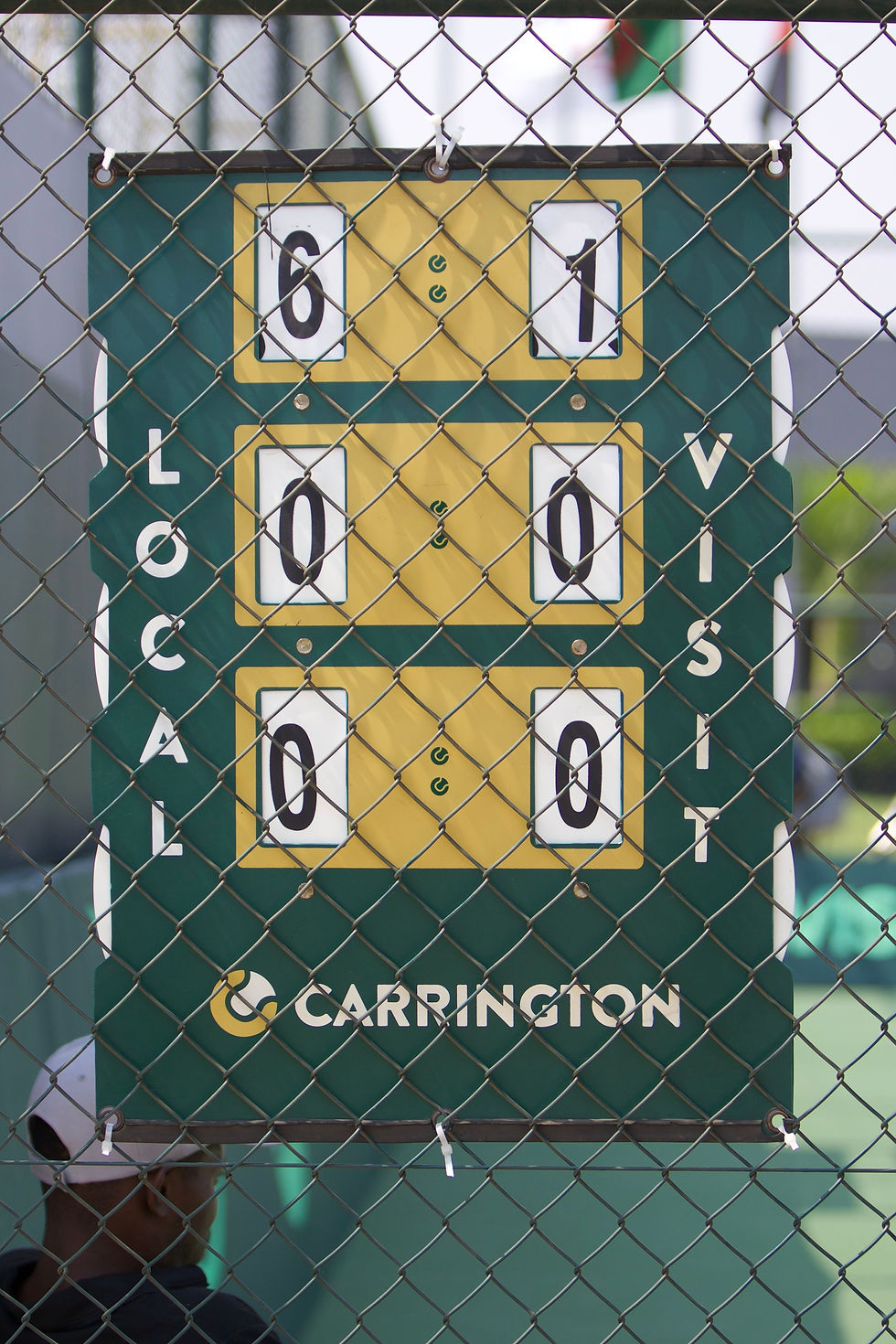
The simple way to remember tennis scoring
If tennis scoring ever feels confusing, reduce it to this:
Points win games. Games win sets. Sets win matches.
Inside a game, remember 15, 30, 40, then game, unless both players reach 40. Then it is deuce, and someone needs two points in a row.
Inside a set, think first to six games, but normally by two. At 6-6, expect a tie-break unless the competition format says otherwise.
That is the charm of tennis scoring. It asks you to keep three scoreboards in your head at once, which is mildly rude, but it also gives the sport its rhythm. A player can be behind in a game, ahead in a set, and level in a match all at the same time. Once you spot those layers, you stop just hearing numbers and start reading the story.


